Minister's daughter
Dead SoulsThe Governor’s daughter is a young woman whose two brief appearances unsettle the self-interested routine of Paul Ivanovitch Chichikov. First glimpsed after his carriage collides with her party, she returns at a provincial ball, where Chichikov’s attention to her becomes conspicuous and helps provoke the ladies’ hostility toward him. Though she has little independent action in the surviving scenes, the contrast between her luminous presence and the surrounding social calculation gives her a distinct narrative function: she briefly makes Chichikov seem capable of feeling beyond acquisition, then becomes caught in the consequences of his public behavior.
Identity and First Appearance
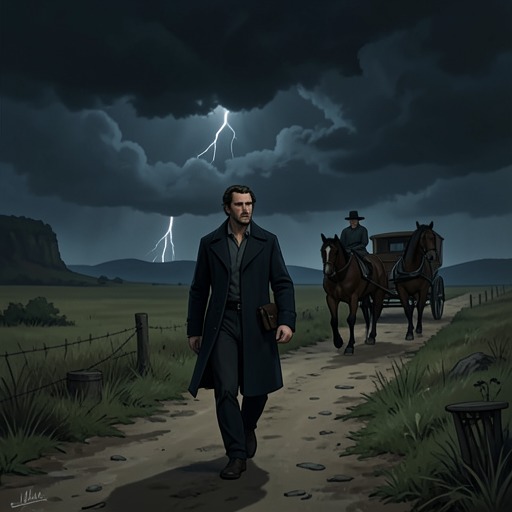
The daughter of the provincial Governor, she is introduced as a girl of about sixteen, traveling with an older woman in a six-horsed carriage. The encounter occurs when that carriage and Chichikov’s britchka become violently entangled on the road. As drivers argue and try unsuccessfully to separate the teams, the young woman and her companion watch with alarm. The narrator singles out the girl’s golden hair, delicate features, and tear-filled eyes; the description makes her immediately memorable amid the noise and confusion of the accident.
The episode is framed as a sudden interruption in Chichikov’s journey. Once the vehicles are disentangled and the two parties depart, he watches the girl disappear, and the narrative returns him to the road, his carriage, Selifan, and the empty fields. The narrator generalizes from this fleeting sight: a radiant thread of joy may break through the fabric of ordinary sorrow, appearing unexpectedly and vanishing just as quickly. The image belongs as much to the narration’s account of perception as to the young woman herself. She is not given a name or a perspective of her own; her first significance lies in the change her appearance produces in the man who sees her.
Recognition at the Governor’s Ball
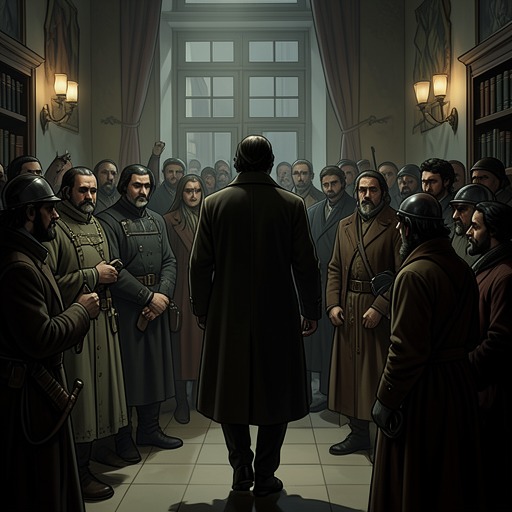
The daughter reappears at a ball, standing beside her mother, the Governor’s wife. When her mother introduces her as a girl just returned from school, Chichikov recognizes her as the young woman he encountered on the road. Recognition leaves him unable to speak coherently. He manages to say that he has had the good fortune to meet her before, but his attempt to continue falters. The earlier roadside vision has thus become a social encounter, yet his response remains awkward rather than assured.
The narrative emphasizes how sharply she stands out in the crowded ballroom. Chichikov sees the same golden hair and delicate oval face, which the narrator compares to an image of the Madonna and sets against a crowd that recedes into a misty blur. The orchestra, conversation, and bustle seem to withdraw from his attention; the girl alone remains distinct, like a pale ivory figure against an indistinct background. The scene presents his feeling cautiously: the narrator does not settle whether it is love, but describes something strange and difficult for Chichikov to explain. For a moment, the habitual man of calculation seems to become a poet and to feel young again.
Chichikov’s Pursuit and Social Consequences
Chichikov presses through the guests to reach the mother and daughter, even jostling the Commissioner of Taxes and making the Postmaster give ground. Yet when he arrives, the confidence of that push gives way to diffidence: he approaches awkwardly and takes the empty chair beside them. His conversation gradually gains momentum, but he fails to notice that the girl begins to yawn. He tells her about adventures from different parts of the world and touches on Greek philosophy, while the narrator’s account makes the mismatch between his effort and her response plain.
His concentration on the Governor’s daughter also has consequences beyond their conversation. Other women at the ball take offense at his behavior. One passes deliberately close, jostling the girl and flicking her face with the end of a scarf; another directs a sarcastic remark at Chichikov. He either fails to hear it or pretends not to. Dissatisfaction spreads across the women’s faces, and verses composed at the expense of dancers become part of the gathering’s social mockery. The narrator says that a tacit proscription comes to fall on both Chichikov and the young woman. The girl is therefore implicated in a censure she has not been shown to cause: her presence draws Chichikov’s attention, and his disregard for the other women makes the pair a visible target.
Narrative Role and Limits
The two encounters form a deliberate contrast with the business-minded journey surrounding them. The roadside appearance interrupts a practical trip; its return at the ball temporarily dims the entertainment and social traffic around Chichikov. But the change in him is uncertain and temporary. He moves from the image of a young man momentarily awakened to the familiar, self-involved talker who recounts his adventures without noticing the girl’s boredom. The contrast gives the episode its irony: an apparent opening toward feeling does not erase his habits of self-display.
The daughter remains largely an object of observation rather than an agent in the scenes. The narration describes her appearance, reports her introduction by her mother, and records her yawning, but provides no account of her thoughts or wishes. That limitation is part of the episode’s design: the reader encounters her through the sudden intensity of Chichikov’s gaze and through the narrator’s reflections on beauty, youth, and the capacity to be surprised by life. Her appearance briefly redirects the novel’s attention from transactions and reputation toward an experience that Chichikov cannot readily name; the ensuing social reaction then returns that experience to the world of public judgment.